[2019]
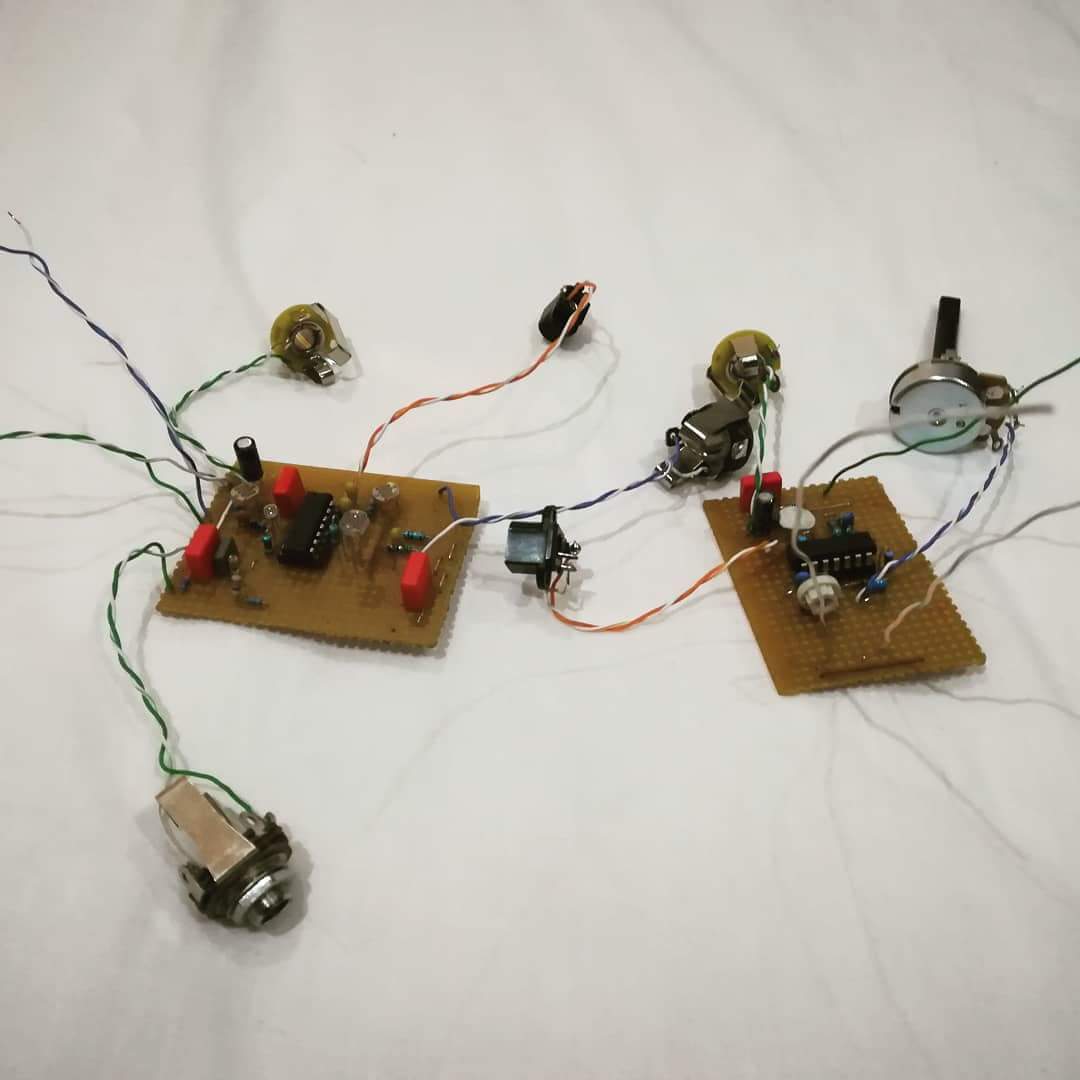
Twin “theremins” that Rhea Dally and Jacques Van Zyl constructed, wonkily named Theremoon and Therenody (Therenody would work better in moonlight. Hence why there’s a prestik on the eye. Daylight is too much for her). The former started off as a simple optical theremin. As work progressed, two PWM switching amps were added (one with widely variable oscillation frequency qua an LDR, dipping well into the audible domain, and the other fixed.) Then a second optical theremin was added, this time nested in a three-neuron Nv nerve net with a PIO (power, in, out) port. Finally the Nv net was routed through a filter, which did a surprising job of filtering a wide range of frequencies down to sine-like waves.
The latter started off as a “standard” heterodyne theremin, utilising two square-wave radio-frequency oscillators, a NOR gate and a low-pass filter. Unfortunately the two oscillators proved prone to injection locking, so a plan had to be made. A third and fourth oscillator were added, one with a widely variable frequency range, but neither was physically connected to the NOR gate. Finally three antennae were added. The result was a proximity-sensitive, wide-band noise synthesizer with extreme variability of output.